Is Xiuyan Jade Jadeite? A Pendant Material Checklist
本文目录
A pendant disclosed as serpentine stone, traditionally called Xiuyan jade, is not being identified as jadeite. Keep the material name, treatment information and any laboratory report separate. The word jade in a product name cannot answer all three questions.
This guide from JADE ALL DAY helps you read a pendant description and record what it actually says. You can use the checklist with another retailer or a piece you already own. Our own anime listings appear below as examples of seller disclosure, rather than laboratory-tested specimens for this article.
What does Xiuyan jade mean?
In the usage relevant to our character carvings, Xiuyan jade is a traditional name for serpentine material. A Gems & Gemology report on serpentine discusses that usage. SSEF’s jade terminology guide also explains that historical Chinese jade names can cover serpentine-group materials, while its laboratory identifications use mineralogical and chemical evidence.
GIA’s current jade overview names jadeite and nephrite and also includes green omphacite under certain conditions. This is not a reason to treat every stone called jade as interchangeable. When a seller says serpentine, do not replace that description with jadeite or nephrite in your own notes.
This guide addresses the serpentine usage of Xiuyan or Xiuyu jade. It does not identify every stone sold under a geographical or traditional name. The name alone is not a report identifying the particular carving or documenting where its stone was mined.
Use this material-claim checklist
Copy the exact wording before interpreting it. Record the product link or piece number and the date, so an answer remains attached to the item you mean. The table is an editorial reading aid, not a mineral identification test.
↔ 小屏幕可左右滑动,对照查看各列。
| Wording you find | What you can record | What still needs an answer |
|---|---|---|
| Jade, natural stone or a character name alone | A broad description or design name | Which material is the seller disclosing? |
| Serpentine stone, traditionally called Xiuyan jade | The seller identifies the material as serpentine | What treatment information and item-specific documents are available? |
| Natural | The seller uses that description | What does natural mean here, and is treatment addressed separately? |
| Treatment not specified | The description leaves treatment unresolved | Can the seller provide a treatment statement for this item? |
| Certificate not included | The purchase does not include the stated document | Is any item-specific report available, if you require one? |
For example, a pendant can have a specific material disclosure while leaving treatment unspecified. That is a more precise record than either “everything is verified” or “nothing is known.” Do not infer untreated from the word natural. A missing certificate is not proof that a stone is imitation, and it is not independent confirmation of its identity. A seller’s product card should also be distinguished from a laboratory identification report.
Keep material and treatment in separate fields
A material name does not settle whether something has been applied to its surface. The 2016 serpentine case published in Gems & Gemology describes a carving whose interior was identified as serpentine and whose surface had a polymer coating. The case illustrates why identification and treatment are separate questions.
It does not show that every serpentine carving is coated, or that any JADE ALL DAY pendant has that treatment. We have not tested the items discussed here. For our examples, the supported statement is the current listing’s disclosure, with its gaps left visible.
Worked example: two anime pendant listings
Checked on 25 October 2026, our Hatsune Miku Portrait Edition D37B and Full Body Design 3A46 both disclose Serpentine Jade, state that a treatment grade is not specified, and say that a certificate is not included. These are statements on the individual product pages.
A careful record would be: “D37B or 3A46; seller-disclosed serpentine; treatment unspecified; certificate not included; listing checked 25 October 2026.” It should not become “certified untreated jadeite.” The separate custom character policy describes its material as serpentine stone, traditionally known as Xiuyan jade. A policy for a service and the disclosure for a listed pendant should each be read in their own context.
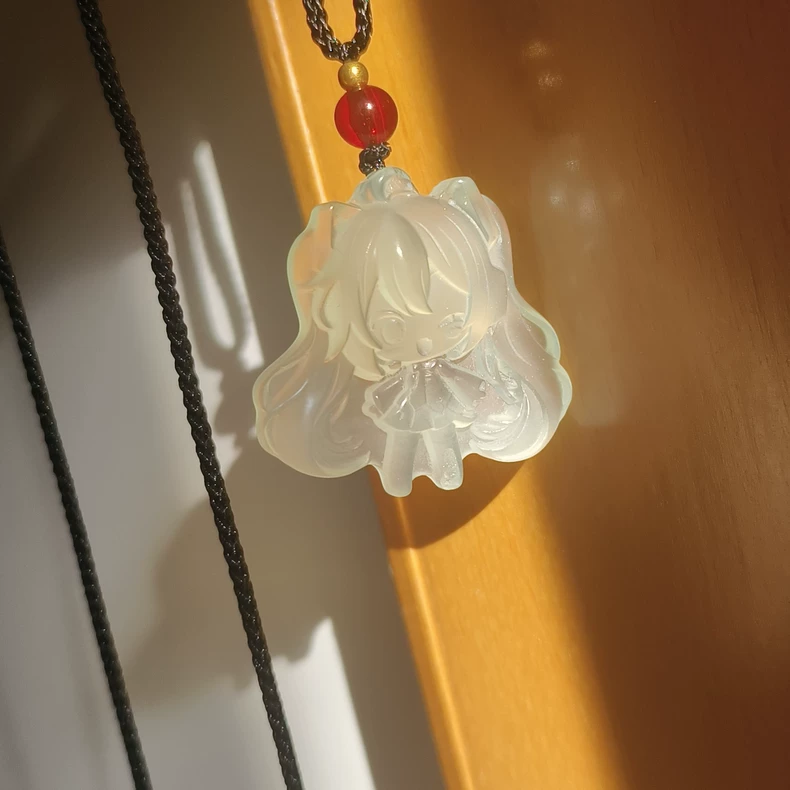
The design photograph helps you inspect a character’s expression and outline. It does not identify the mineral. D37B’s current gallery is described as AI-assisted presentation imagery, so it should not be treated as an unaltered photographic comparison of stone color. The custom service’s concept illustration is also not a photograph of a completed order.
Questions you can copy to a seller
Item link or piece number:
Date checked:
What exact material are you disclosing for this item?
What treatments, if any, are disclosed, and what supports that statement?
Is a laboratory identification report for this item included or available?
If so, which laboratory issued it, and how can I check the item details?
Keep the reply with the listing. If an answer is unknown, record unknown rather than converting silence into a claim. A statement from a seller and a finding in a laboratory report are different sources of information; label them accordingly. If a report is supplied, read its identification and treatment findings and check that it refers to the item being offered. SSEF’s report guide explains its own identification fields and report verification; other laboratories use their own formats.
When to pause the purchase
If your requirement is jadeite, a listing that discloses serpentine does not meet that requirement. If your requirement is documented treatment status, an unspecified treatment statement leaves that requirement open. Ask before paying, or choose an item whose documented information meets your needs.
If you mainly want a character carving and are comfortable with seller-disclosed serpentine, you can make that decision without calling it jadeite. Once the material question is settled, our anime jewelry gift guide covers the separate questions of recipient preferences, accessories and timing.
Sources and scope
Sources and product disclosures checked . Published by JADE ALL DAY, a retailer of the example pendants. The checklist and question template are editorial tools, not a laboratory method, appraisal or test report. We performed no physical examination or new material testing for this article.
Primary references: GIA’s jade overview for material terminology; SSEF’s jade report guide for historical names and its report fields; and Larry Tai-An Lai’s Polymer-Coated Serpentine, Gems & Gemology, Summer 2016, for the single tested case. None is a report on, or an endorsement of, our products.
延伸阅读
继续阅读更多手记