What Is Blue Water Jadeite? Color, Translucency and Type A
本文目录
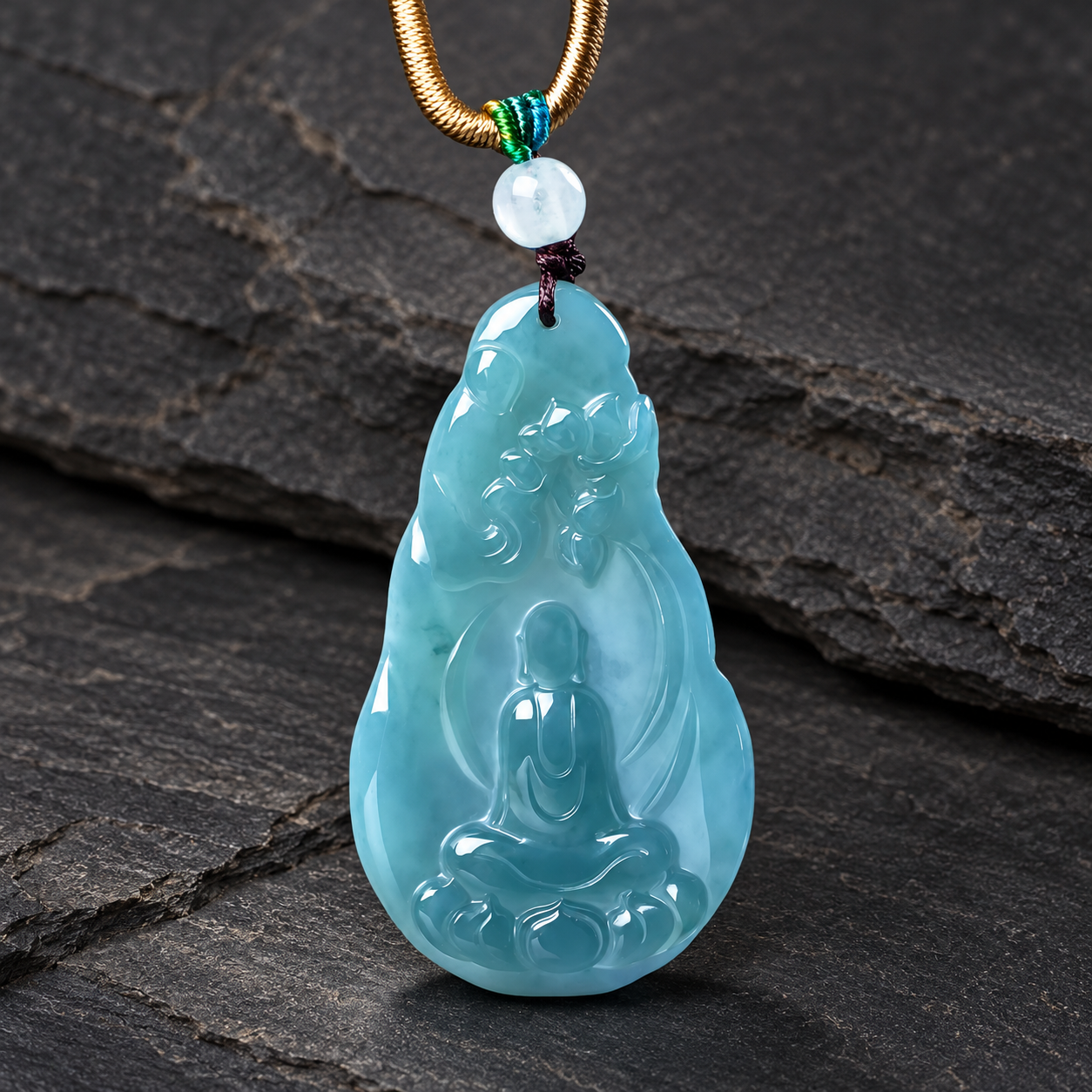
Blue Water jadeite is a trade description for jadeite with a blue to blue-green appearance and a translucent, water-like look. It combines color with the way light passes through the stone. It does not, by itself, establish treatment status, country of origin or an overall quality grade.
This guide uses JADE ALL DAY’s pendant No. 7330 as a practical example. The aim is to help you describe and compare a stone, whether you are shopping or simply learning to recognize jadeite terminology.
What does “Blue Water” mean?
Zhang and Shi’s 2022 study describes blue, bluish-green and grayish-blue jadeite from Myanmar and Guatemala. Its terminology is useful, but the study does not grade our pendant. Read the study’s description and sample scope (Section 2.1, PDF).
Think of the name as two observations to make separately: What is the body color? And how much light seems to enter the stone? A blue photograph alone answers neither question completely.
↔ 小屏幕可左右滑动,对照查看各列。
| Label | What it describes | What to verify separately |
|---|---|---|
| Blue Water | A combination of color and translucent appearance. | The appearance of the individual stone in useful lighting. |
| Icy or glassy | Trade descriptions emphasizing transparent-looking appearance. | Color, treatment status and the actual viewing conditions. |
| Type A | A treatment classification. | Appearance and quality; A is not a score for beauty. |
| Guatemala or Myanmar | An origin statement. | The evidence supporting that statement for the particular item. |
Read the color and translucency separately
GIA’s educational guide discusses color, transparency and texture as jadeite quality factors, and recommends checking color under different light sources. Jadeite ranges from opaque to semitransparent; grain structure affects texture. Keep these observations separate when describing a piece. See GIA’s jadeite quality factors.
For a carving, first establish which parts are thicker or thinner from a side view or measurements; the outline alone is not enough. Compare a broad area of the body with the edges and raised details. A bright edge is not a description of the entire pendant. Reflections from polished surfaces can also compete with the body color in a photograph. Record which area you are describing instead of calling the whole piece “clear” from one attractive view.
A piece can be described as both “Blue Water” and “icy.” For more on those overlapping trade terms, see our guide to jadeite color and translucency.
Guatemalan vs. Myanmar jadeite: what actually differs?
Both countries produce jadeite jade. Here, the comparison concerns that material, rather than every stone sold with the word “jade.” Origin describes where a stone formed; it does not replace material identification or an assessment of the individual carving.
↔ 小屏幕可左右滑动,对照查看各列。
| Aspect | Guatemala | Myanmar (Burma) |
|---|---|---|
| Material identity | Jadeite jade occurs here. | Jadeite jade occurs here. |
| Blue Water appearance | Blue and blue-green examples are documented. | Blue and blue-green examples are documented. |
| 2022 selected blue-water sample groups | Higher omphacite and total iron in this sample group. | Lower omphacite and total iron in this sample group. |
| Treatment status | Must be assessed separately from origin. | Must be assessed separately from origin. |
The chemical comparison above comes from Zhang and Shi’s blue-water study (Sections 3–4, PDF). Its Guatemalan specimens also showed more mineral inclusions and compositional variation. The authors used spectroscopy and acknowledged limited sampling. These findings are not a visual checklist that identifies every stone from either country.
Guatemalan material is not uniformly dark or opaque. A separate 2024 Gems & Gemology study examined ten fine-textured “ice jade” samples reported from Guatemala’s Morales mine. They were predominantly jadeite with small amounts of omphacite and albite, and showed good transparency. This is a useful counterexample to the idea that all Guatemalan jadeite has one composition or appearance. Read Huang and colleagues’ “Ice Jade” from Guatemala.
Origin alone does not rank a particular pendant. First compare the actual color, translucency, texture, visible fissures, carving and dimensions. Then check material, treatment and origin evidence separately; a seller’s country label is not a substitute for those observations. A national origin does not establish Type A, and a general gem identification certificate may leave origin unaddressed. If provenance affects your choice, check what evidence actually supports it.
For No. 7330, “Guatemala” remains our listing disclosure. This article has not measured its iron content, identified its accessory minerals or obtained an independent origin conclusion. The studies explain what researchers can compare; they do not authenticate this pendant.
A worked example: pendant No. 7330
Our Type A Blue Water Seated Buddha pendant, No. 7330, provides a concrete example of how to read a listing. As checked on 25 October 2026, the page describes natural jadeite, a seated Buddha on a lotus base and origin Guatemala. It offers a physical identification certificate as an optional add-on.
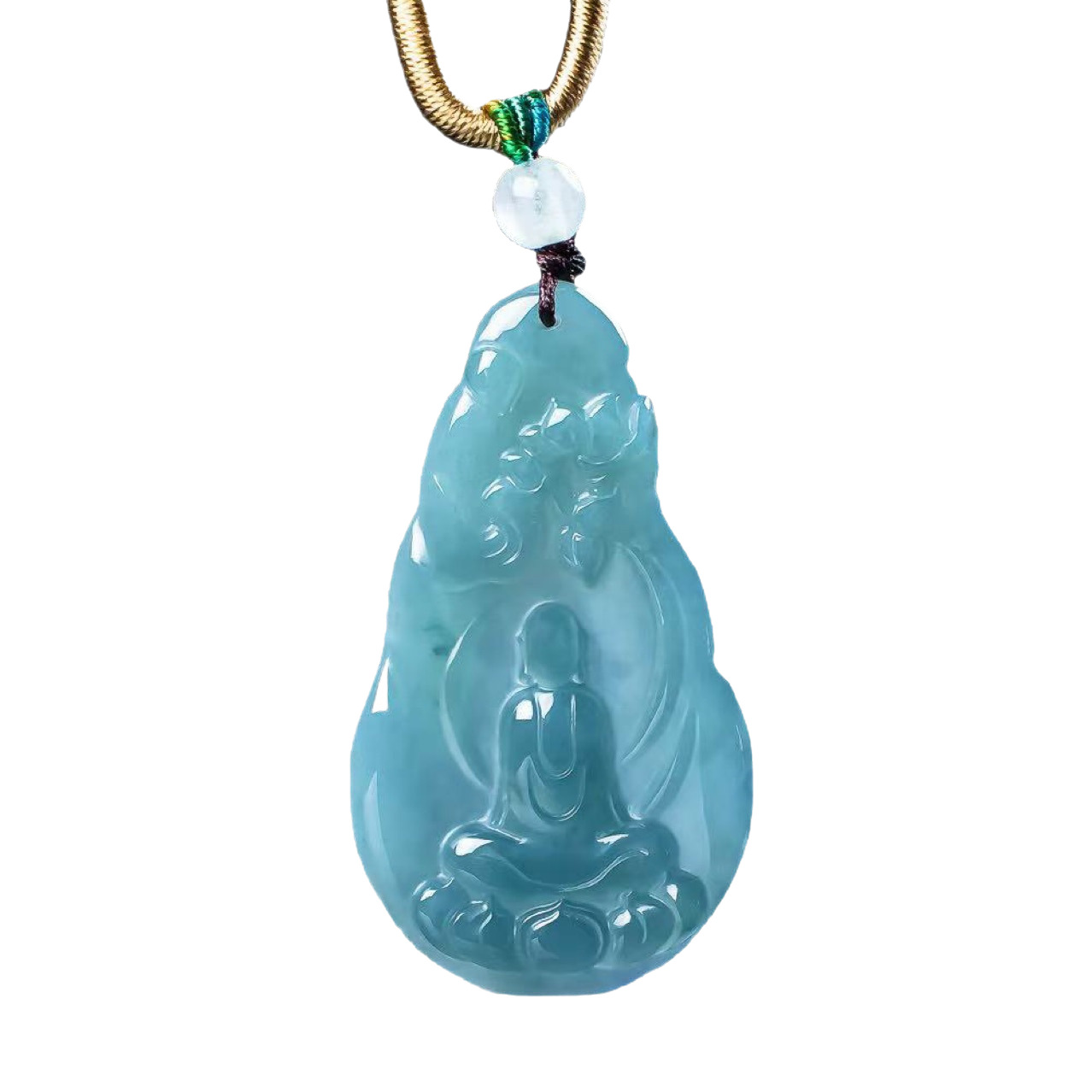
In this supplied photograph, the pendant appears blue-green, with a rounded pear-shaped outline and carved relief. Those image observations are useful for describing its appearance; mineral identity, treatment and origin require separate evidence.
↔ 小屏幕可左右滑动,对照查看各列。
| What the example supplies | How to use it |
|---|---|
| A Blue Water appearance and carved design | A visual reference for discussing the color family and form. |
| Type A and Guatemala in the listing | Seller disclosures; do not treat the photograph as proof of either claim. |
| An optional physical identification certificate | Check the selected option and the actual report’s findings; no report was examined for this article. |
| 30 g with packaging | Shipping weight, not a measured net weight of the pendant. |
The listing also says its images show the style and that natural stones vary. If you need the exact shade or dimensions of the piece you will receive, ask for those details before choosing it. This pendant is an example of the description, not a universal standard against which all Blue Water jadeite must match.
A practical lighting check for any Blue Water pendant
Use the following sequence when requesting photographs or examining a piece. It is a comparison method, not an authentication test.
1. Start with an ordinary front view. Ask for the stone against a neutral background in diffuse daylight, without filters, plus a view in ordinary indoor light. Note whether it appears predominantly blue, blue-green or gray-blue. Avoid comparing two sellers’ images as if the cameras and lighting were identical.
2. Keep the view and background consistent. For a comparison of two pieces, request them in the same frame if possible. Record the lighting and the area you are judging. A screenshot with unknown editing is a weak reference for a subtle color difference.
3. Check front, back and side. Ask for dimensions including thickness. Examine a broad section as well as thin edges. A strong backlight can be useful for viewing internal features, but keep it separate from your record of the pendant’s normal face-up appearance.
4. Describe what remains uncertain. If all available views are strongly backlit, you do not yet have a normal-light comparison. If you cannot obtain thickness or exact-piece images, record that gap rather than inventing a transparency grade.
Type A and origin answer different questions
GIA describes A jade as natural jade or jade polished with wax only; B involves acid bleaching and polymer impregnation, and C involves dyeing. Thus, Type A concerns treatment, not a top-tier color grade. A Blue Water label does not establish Type A status. Read GIA’s jade buyer’s guide, or our longer explanation of natural and treated jadeite.
Blue color is not exclusive to one country. GIA’s 2024 report on Guatemalan jadeite documented blue material as well as green and lavender examples. That supports the existence of blue Guatemalan jadeite; it does not authenticate the origin of No. 7330. See Tao Hsu’s report in Gems & Gemology.
For an individual pendant, read any identification report for its actual scope. Does it identify the material and state treatment findings? Does it make an origin conclusion, or leave origin unaddressed? Do not fill in an omitted conclusion from the color, the word “certificate” or the product title.
A Blue Water comparison card you can reuse
Copy these fields into a note for each pendant. The purpose is a clear, comparable description, not a homemade gem grade.
Item or reference:
Images: exact piece / style only
Daylight body color:
Indoor body color:
Lighting, background and filters:
Broad face versus thin edge:
Dimensions, including thickness:
Material:
  seller claim / report / unknown
Treatment:
  seller claim / report / unknown
Origin:
  seller claim / report / unknown
Report issuer and number:
Report matched to this piece?
Remaining questions:
Pause if you require an exact match to a stylized image, if the color looks appealing only under intense backlighting, or if a treatment or origin conclusion matters to you but has no supporting evidence. A useful result may be deciding that a different stone, more documentation or no purchase is the better choice.
Sources and scope
Gemological sources are linked beside the claims they support. The comparison sequence and card are JADE ALL DAY’s editorial tools. The No. 7330 example uses our current listing and an existing supplier photograph; listing statements are distinguished from image observations and laboratory findings. Product details and links were checked on 25 October 2026. No physical examination, color measurement or independent laboratory verification of No. 7330 was performed for this article.
延伸阅读
继续阅读更多手记