Will Your Chain Fit a Pendant? Follow the End Fittings
本文目录
To check whether a chain will fit a pendant, identify the end that would be threaded through the pendant, then compare every fixed fitting on that route with the pendant’s clear opening. The chain body’s advertised width alone is not enough. A chain can be slender while its end ring, tag or clasp cannot pass through the opening.
This guide helps you describe a pendant-and-necklace combination before buying or changing parts. It also works for jewelry you already own. It is a way to organize a fit question, not a claim that a combination has been physically tested or is suitable for wear.
First choose the threading route
Imagine opening the necklace at its normal clasp and bringing one end toward the pendant. Which end would go through? On one side it might be a small end ring; on the other it might be the clasp body. Record the proposed side rather than assuming the clasp must always pass through.
Follow that end along the whole intended route. Include a fixed tag, cap, connector or bulky link that would also need to pass. Photograph both necklace ends together, label the intended entry end, and keep that view with the pendant reference. Open only the clasp in its normal way; this worksheet does not ask you to cut a chain or open a connecting ring. A hinged or opening bail fitted around a necklace uses a different assembly route; ask how that specific mechanism is intended to work rather than applying a threading assumption to it.
Rio Grande makes the key distinction in its chain guide, page 2, “Chain Width and Length”: finished-chain selection needs an end-ring-to-bail check as well as chain width. Our route method applies that distinction to the particular necklace arrangement you describe.
Measure the opening, not the outside decoration
A bail is the loop or fitting through which a necklace passes. Some stone pendants instead use a drilled hole, a cord arrangement or a connector. Identify which opening you actually intend to use. A decorative bail’s outside dimensions are not its inside clearance, and a carving’s overall height says nothing about that clearance.
The pendant side
Ask for the clear inside height and width at the narrowest relevant opening, in millimeters, plus a view showing the measurement points. For a drilled passage, also ask about the passage’s direction and depth: a shallow face opening and a long tunnel are different paths. If a cord or knot is already in place, clarify whether it would remain. Do not treat occupied space as an empty opening.
The necklace side
Record the widest part of the chain body and the dimensions of each fixed fitting that must pass along the chosen route. Rio Grande defines chain width across the outside of its widest link in the same guide. Ask what any quoted “clasp size” measures; one outside length does not describe every cross-section that may have to pass.
The information source
Keep the unit, date and measurement source beside each number. A seller’s stated dimension, your approximate ruler reading and a jeweler’s examination are different evidence. A photograph without a reliable scale should leave a measurement unresolved. If an opening is awkward to reach, ask for a measurement rather than pushing a metal tool into it.
A small chain can still have a blocked route
Consider a deliberately simple, hypothetical example: a chain body is 1.2 mm across, the pendant has a circular 2 mm opening, and the chosen entry end has a fixed spherical bead 4 mm in diameter. The chain-body number does not reveal the obstruction: that 4 mm sphere cannot pass through the 2 mm opening.
Those numbers describe no product in our shop and no experiment we performed. Real end fittings and openings are often not circular. Their shape, orientation and the depth of the passage matter, so two favorable width numbers should be recorded as a dimensional candidate, not a completed fit test.
Give the fit question a useful status
Information missing: the opening, intended route or a fixed fitting has not been described. Request that specific information; another overall photograph may not answer it.
Dimensional candidate: the recorded measurements appear to allow the proposed route, but the actual combination has not been checked. Retain shape and passage-depth questions.
Route blocked: a known fixed component cannot pass through the intended opening. Do not force it. Ask whether a different necklace or a professionally assessed attachment arrangement is appropriate.
Pass-through physically checked: record who checked the actual components, when, and which threading method was used. This status addresses that passage only. It does not establish the strength, condition or suitability for wear of the assembled necklace.
What a cord option does—and does not—tell you
As checked on 31 October 2026, our Miku Full Body Design pendant, No. 3A46, offers a pendant-only choice or an optional braided cord and packaging box. Its accessory is a cord, not a metal chain. That disclosure does not establish compatibility with a chain you already own.
If you want to reuse your necklace, identify its entry end and ask for the pendant opening and an assessment of that proposed combination before ordering. Do not infer an opening size from the styled product photographs. The absence of a measurement leaves a fit question open; it does not establish that the piece will or will not fit.
Our pendant size and paper-outline guide addresses how much space a carving occupies. That is separate from the path through its attachment. For a commissioned piece, the custom reference preparation guide explains why an essential requirement should be discussed before an order rather than assumed from an uploaded reference.
Copy this chain-fit request
Pendant link or identifying reference: [ ]
Date and source of measurements: [ ]
Attachment type and clear inside opening: [ ]
Necklace and intended entry end: [ ]
Chain-body width: [ ]
Fixed parts along that route and their dimensions: [ ]
Shape, passage depth or occupied-space questions: [ ]
Status: information missing / dimensional candidate / route blocked / pass-through physically checked
Question: Can these actual components use this route without alteration, and what further examination is needed for the complete wearing arrangement?
Attach clearly labeled views of the pendant opening and both necklace ends. If a seller or jeweler proposes changing a fitting, keep that proposed arrangement separate from the original one and ask what work and checks it requires. A changed clasp or connector calls for a new route check.
Passing through is only one decision
Rio Grande’s chain guide separately advises selecting chain with enough strength for the pendant and other design elements. A passage measurement does not supply a load rating or assess worn links, an attachment’s condition or how the piece will hang. This article offers no universal chain-width-to-pendant-weight rule.
If compatibility is essential and the measurements or a suitable assessment remain unavailable, you can keep the existing arrangement, choose a documented combination or postpone the change. Enlarging a stone hole, bending a bail or altering a clasp is not part of this worksheet.
Sources, photograph and scope
Sources checked 31 October 2026. JADE ALL DAY is a jewelry retailer. Rio Grande’s supplier guide supports the chain-width, end-ring and strength distinctions beside the relevant paragraphs. The route record, hypothetical sphere example, four statuses and request card are our editorial reasoning and communication tools. We have not measured No. 3A46’s opening, assembled a chain with it or performed a load or wearing test for this article.
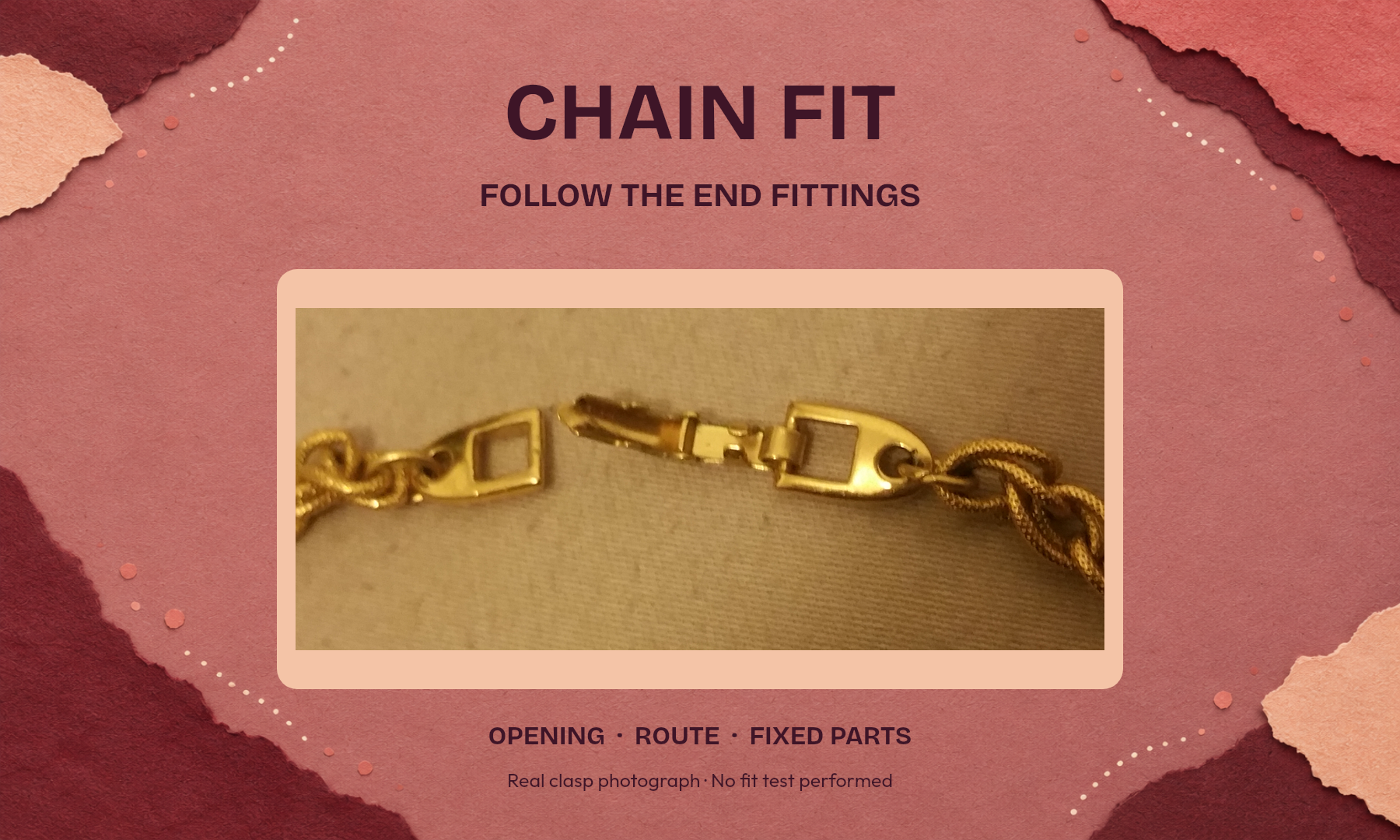
The cover uses Shani Evenstein’s “Necklace clasp 05” photograph, licensed CC BY-SA 4.0. The real clasp photograph is cropped and proportionally resized in an editorial layout with an AI-assisted decorative background; the metal components are not generated or recolored. The cover adaptation is also available under CC BY-SA 4.0. It is not a JADE ALL DAY product, a scale drawing, a material identification or proof of pendant compatibility. The graphic license does not change the license of this article’s text or other website materials.
延伸阅读
继续阅读更多手记