Jade and Ornamental Stones: 15 Names and How They Form
本文目录
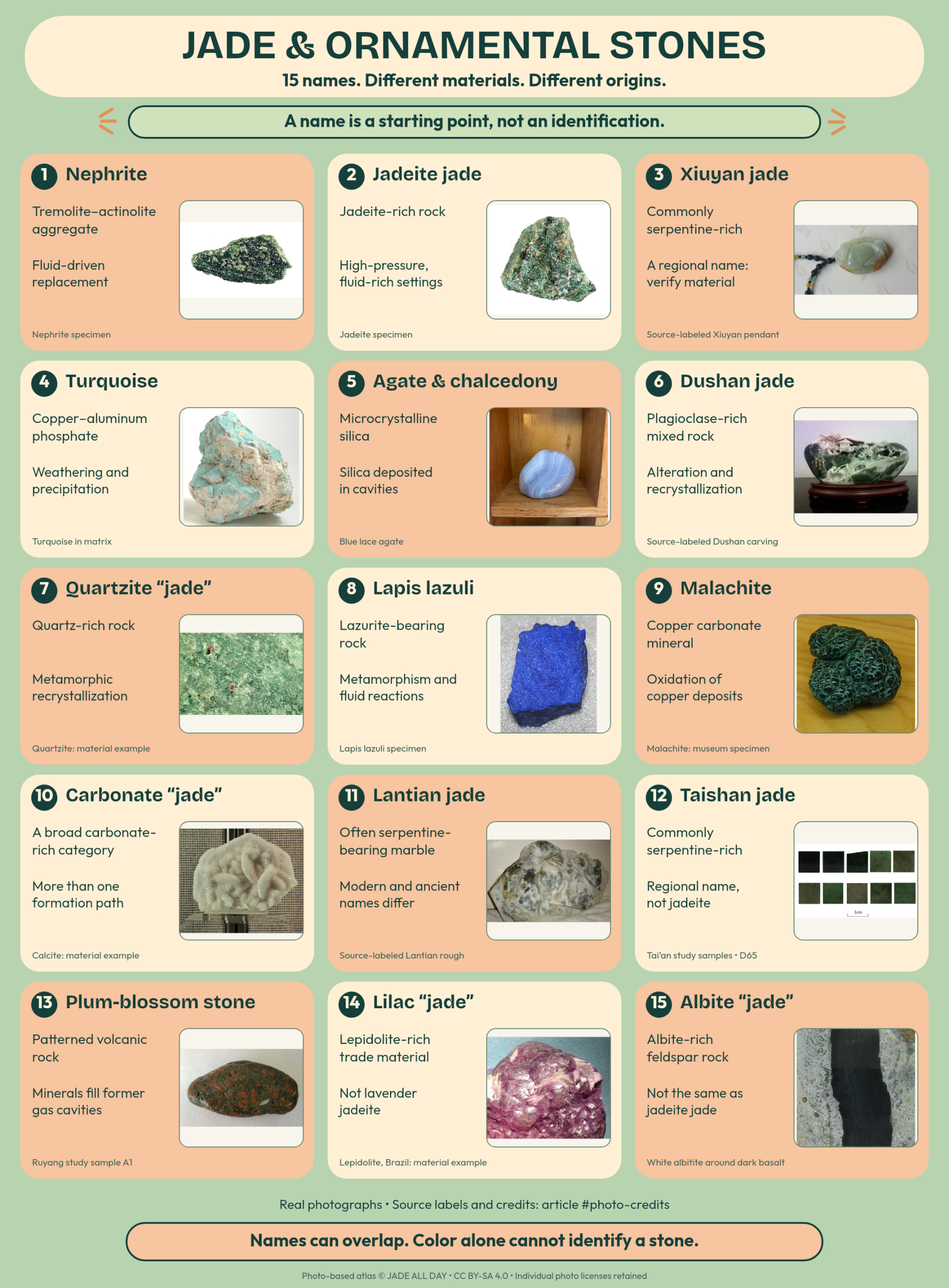
The 15 names in this chart do not describe 15 kinds of jade. They mix gem materials, mineral varieties, rocks, broad composition labels and regional or trade names. Reading the name alongside the actual material is more useful than sorting stones by color.
Nephrite and jadeite jade are central to gemological jade terminology. GIA also includes green omphacite under certain conditions; the boundary is more nuanced than a rigid “only two minerals” rule. Turquoise, lapis lazuli, malachite and the other ornamental materials below should retain their own identities.
This guide is for reading a collection label, a museum display or a seller’s description. The chart is a comparison of names and geological contexts, not a visual test for an unknown stone.
The English chart: 15 names, separate examples
The numbered entries preserve the subjects of a reader-supplied Chinese infographic while correcting the English framing. Separate photographs replace the original composite-rock arrangement: these materials are not shown as naturally growing together. The photo captions distinguish source-labeled regional objects from examples of a material family.
First separate a mineral, a rock and a name
A mineral species has a characteristic composition and crystal structure. A rock is an aggregate of minerals: its name describes the whole material, not just one attractive grain. A variety name describes a particular form, while a trade or regional name can reflect appearance, tradition or a place.
These categories overlap. “Lapis lazuli” names a rock; lazurite is one of its minerals. “Agate” describes a banded form of chalcedony. “Lantian jade” requires historical and local context. The quotation marks around some uses of “jade” below flag that naming issue; they do not mean the material is artificial or worthless.
1–5: Nephrite, jadeite, Xiuyan, turquoise and agate
↔ 小屏幕可左右滑动,对照查看各列。
| Name in the chart | Material and geological context | What the name cannot establish |
|---|---|---|
| 1. Nephrite (often called Hetian jade) | An aggregate dominated by tremolite–actinolite amphiboles. Fluid-driven replacement can involve dolomite-rich rock or serpentinite; these are different geological routes. GIA: nephrite formation. | “Hetian” wording on its own is insufficient to document where an individual object was mined. |
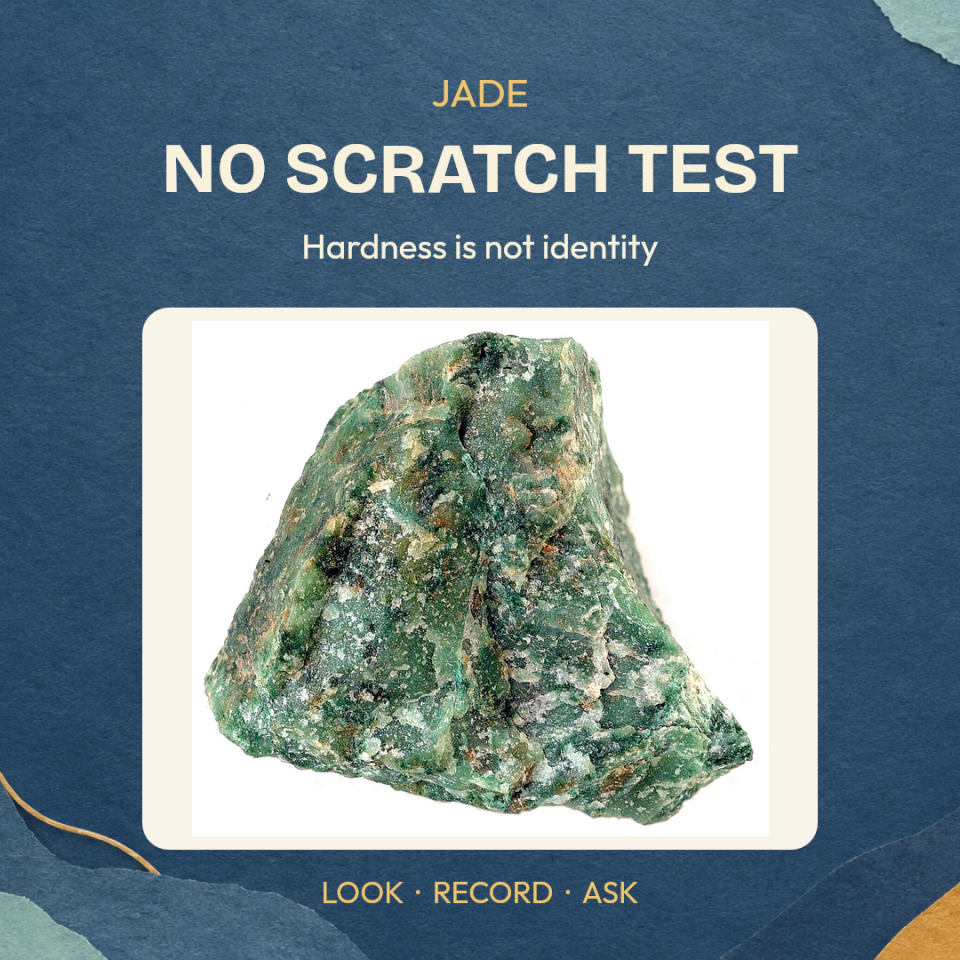
| 2. Jadeite jade (fei cui) | A rock dominated by jadeite, sometimes with related pyroxenes and accessory minerals. High-pressure subduction settings and fluid reactions are important to its formation. GIA: jadeite formation. | A green color or translucent appearance does not establish identity, treatment or geographic origin. |
| 3. Xiuyan jade (Xiuyu) | Commonly used for serpentine-rich carving material. A Raman study distinguishes serpentine-rich Xiuyan material from nephrite and jadeite. Zhao et al.: Raman identification. | The district also produces nephrite, so a regional name is not a universal composition. GIA: Xiuyan nephrite sources. |
| 4. Turquoise | A hydrated copper–aluminum phosphate. A Tianhu East study proposes weathering, transport of dissolved constituents and precipitation in fractures. Liu et al.: Tianhu East turquoise. | That deposit model is an example, not proof that every turquoise deposit has identical host rocks or fluid history. |
| 5. Agate & chalcedony | Chalcedony is fine-grained silica; agate is a banded variety. Agate can be deposited in cavities or veins. Kansas Geological Survey: agate. The Smithsonian describes common volcanic-cavity examples. Smithsonian: agate. | The two words are not two unrelated mineral species. Bands in a picture do not establish whether a particular object is natural or treated. |
6–10: Dushan, quartzite, lapis, malachite and carbonates
↔ 小屏幕可左右滑动,对照查看各列。
| Name in the chart | Material and geological context | What the name cannot establish |
|---|---|---|
| 6. Dushan jade | A plagioclase-rich mixed rock. The CUG museum specimen is described as altered anorthosite. A Nanyang study links jade formation to deformation and later fluid-driven alteration and recrystallization. 2024 formation study (abstract, in Chinese). | Its multicolored appearance is not evidence that it contains jadeite. Composition and geological history must be investigated separately. |
| 7. Quartzite “jade” | A quartz-rich rock. The USGS definition describes metamorphic recrystallization of sandstone or chert. USGS: quartzite. | “Jade” in the trade label does not turn quartzite into nephrite or jadeite. Other quartz-rich rocks need their own identification. |
| 8. Lapis lazuli | A rock containing lazurite with other minerals, often calcite and pyrite. GIA: lapis composition. A Chilean deposit illustrates carbonate-rock metamorphism followed by sulfur-bearing fluid effects. Lapis Lazuli from Chile, pp. 28–41. | It is not one blue mineral, and the Chilean deposit history is not a universal origin model for all lapis. |
| 9. Malachite | A copper carbonate hydroxide mineral. It is a secondary mineral in oxidized portions of copper deposits. Ohio geological resource: malachite. | Its green color and bands do not make it jadeite, nephrite or a substitute with the same material properties. |
| 10. Carbonate “jade” | A broad compositional label, rather than one species. Calcite-rich ornamental materials can include marble or precipitated carbonate deposits; calcite occurs in several geological environments. University of Minnesota: calcite. | A single formation story cannot cover the category. First identify the actual carbonate minerals and rock. |
11–15: Regional and trade names that need context
↔ 小屏幕可左右滑动,对照查看各列。
| Name in the chart | Material and geological context | What the name cannot establish |
|---|---|---|
| 11. Lantian jade | A historical and regional name. The study discusses modern serpentinized marble from Shaanxi and argues that modern Lantian material should include serpentine-rich material as well. Peng et al. (2022), abstract. | Do not retrospectively identify every ancient object called “Lantian jade” as that modern material. The historical identification remains debated. |
| 12. Taishan jade | For the Shandong material discussed here, a 2011 study identified serpentine as the main component of its samples. Cheng et al.: Taishan jade. | This is a regional usage, not jadeite. The study specifically left tremolite-bearing material for further verification. |
| 13. Plum-blossom stone (Meihua “jade”) | A patterned volcanic rock with mineral-filled cavities, called amygdules. A Funiu Mountain study found a mixed mineral assemblage in those fillings. Xu et al.: Meihua jade. | The flower-like pattern is not a preserved flower. A name based on appearance does not define one mineral species. |
| 14. Lilac “jade” (Dingxiangzi material) | The Xinjiang trade material studied by Wang et al. was lepidolite-rich rock: lithium mica with lesser albite and traces of quartz. Wang et al.: five studied samples. | This usage is not lavender jadeite. A study of five samples does not identify every purple stone sold under a similar name. |
| 15. Albite “jade” | Albite-rich feldspar rock is distinct from jadeite-rich rock. A Peking University research abstract describes tested albite-rich material resembling translucent jadeite (repository access was intermittent when checked). Albite can also occur with jadeite in mixed material. GIA: high-albite bangles. | Neither translucency nor the presence of some jadeite settles the name of a mixed rock. The mineral assemblage matters. |
Why the formation stories are not one timeline
Several processes can act on the same rock. A parent rock supplies material; heat, pressure, deformation or fluids may change it; later weathering, erosion and transport can expose or move the result. These are different events, and a rounded river pebble does not tell you which earlier reactions formed its minerals.
USGS explains that metamorphism changes existing rocks through heat, pressure and mineral-rich fluids, generally without melting them. Metasomatism emphasizes chemical exchange with fluids. Precipitation deposits material from a fluid, while a cavity filling describes where minerals grew, not one universal chemical recipe.
This distinction explains why similar colors can accompany different histories, and why two pale green stones can need different descriptions. The atlas offers starting contexts. It does not assign an age, a mine or a complete formation history to an individual object.
A four-field stone record you can reuse
For a collection label or research note, keep the original name and the evidence beside it. This editorial template keeps four questions separate: the supplied name, identified material, treatment and geographic origin. It preserves an unknown instead of turning a familiar name into a scientific conclusion.
Object / photo reference:
Date recorded:
Name exactly as supplied:
Material identification:
  Finding / source / object match:
Treatment information:
  Finding / source / still unknown:
Geographic origin:
  Claim / supporting evidence / still unknown:
Example: an object labeled “lilac jade” can be recorded under that supplied name. The published lepidolite study tells you that one Xinjiang trade usage referred to lithium-mica-rich rock. It does not identify your object. Until object-specific evidence is available, its material, treatment and origin fields can remain unresolved.
If you already have a laboratory report, use our report record, item and scope checklist to keep those findings attached to the correct object. Our Xiuyan material guide examines the separate problem of reading a serpentine pendant listing.
What this chart cannot decide for you
- Identify an unknown object from a photograph, color, surface pattern or this chart.
- Establish whether a specific stone is untreated, where it was mined or what it is worth.
- Transfer a jadeite cleaning instruction, treatment label or durability claim to all 15 entries.
- Rank these different materials as if the word “jade” were a quality grade.
If you specifically need jadeite, a disclosure of serpentine, quartzite or lepidolite does not meet that material requirement. If your interest is a carving, color or geological story, another correctly described ornamental stone may suit it. The useful distinction is the material and the evidence, not whether the name sounds prestigious.
Sources, photographs and scope
Sources reviewed 29 October 2026. Published by JADE ALL DAY, a jewelry retailer. This is an editorial synthesis and naming aid, not new mineralogical research, an appraisal or a laboratory identification report. We performed no physical examination or new testing for this article.
The links beside each entry lead to the relevant institution or research publication. Deposit descriptions and sample studies are used within their stated scope; regional trade names can vary. Some linked research is in Chinese, and publisher access may require verification. The Dushan formation statement uses the published abstract; the Lantian entry uses its abstract’s distinction among modern material types and historical uncertainty.
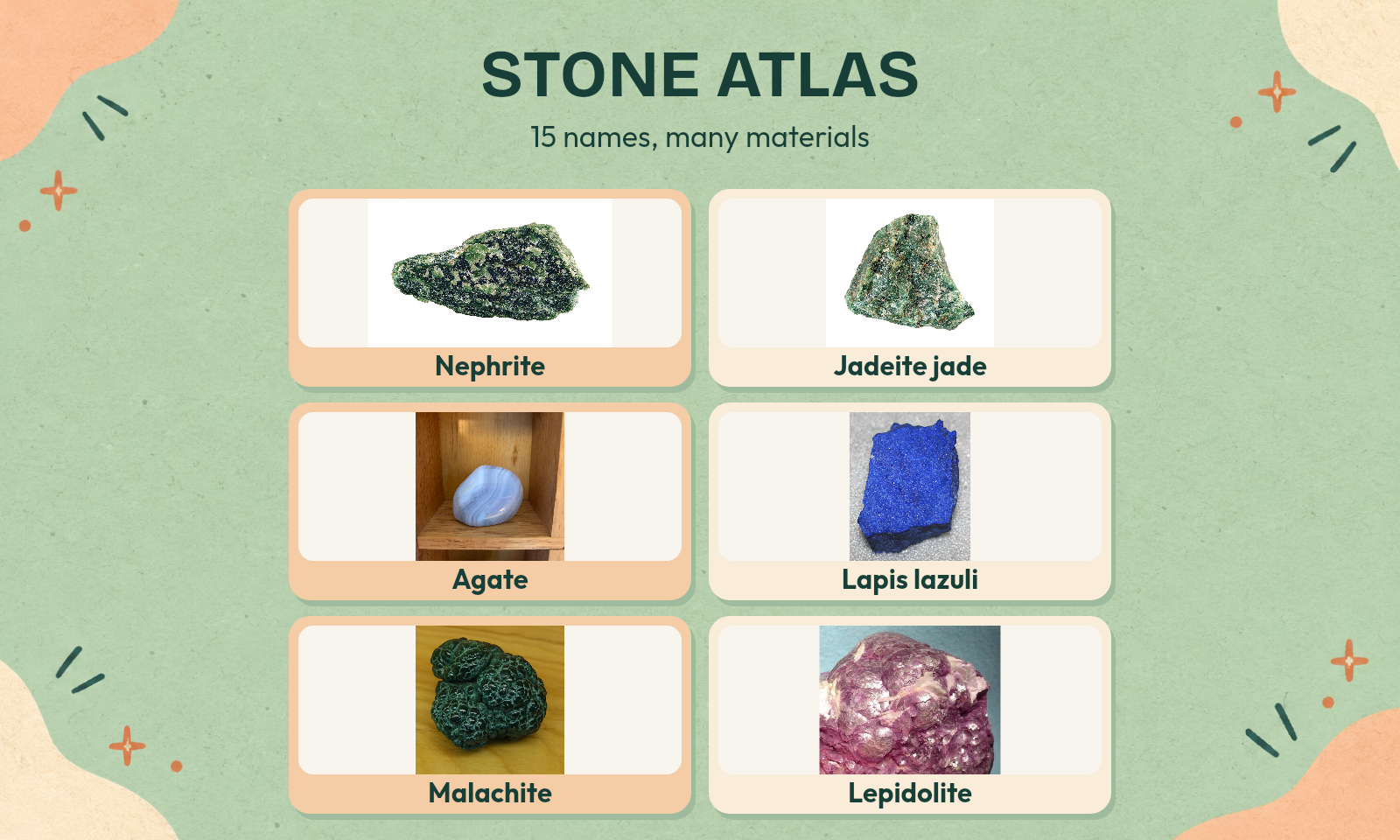
The chart uses existing photographs in an editorial layout. The redesigned cover uses six of those real specimen photographs on an AI-assisted decorative paper background. The specimen photographs were cropped where needed and proportionally scaled; they were not generated, recolored or given invented textures. Source labels are not independent laboratory identifications, and the images are not calibrated color references. The reusable contribution is the sourced name-to-material crosswalk and the record template. For a scientific claim, follow the linked primary source and its own limits.
Photo credits and sample scope
Photographs and reuse terms checked 29 October 2026. Regional object labels follow their source descriptions; we did not authenticate or test these objects. The calcite, quartzite, lepidolite and albitite images illustrate materials, not every item sold under the corresponding trade label. The Taishan row uses photographed Tai’an samples from the cited study; the plum-blossom row uses its study’s Ruyang sample A1. Cover photographs correspond to entries 1, 2, 5, 8, 9 and 14 below.
- 1. Nephrite — Nephrite specimen. Source photograph by Shannon Heinle. CC0. Resized; shown in a rounded frame.
- 2. Jadeite jade — Jadeite specimen. Source photograph by Shannon Heinle. CC0. Resized; shown in a rounded frame.
- 3. Xiuyan jade — Source-labeled Xiuyan pendant. Source photograph by Jason M. C., Han. CC BY-SA 4.0. Resized; shown in a rounded frame.
- 4. Turquoise — Turquoise in matrix. Source photograph by Rob Lavinsky, iRocks.com. CC BY-SA 3.0. Resized; shown in a rounded frame.
- 5. Agate & chalcedony — Blue lace agate. Source photograph by I2Overcome. CC BY 4.0. Resized; shown in a rounded frame.
- 6. Dushan jade — Source-labeled Dushan carving. Source photograph by Artfiber. CC BY-SA 3.0. Resized; shown in a rounded frame.
- 7. Quartzite “jade” — Quartzite: material example. Source photograph by Nessa Eull. CC0. Resized; shown in a rounded frame.
- 8. Lapis lazuli — Lapis lazuli specimen. Source photograph by James St. John. CC BY 2.0. Resized; shown in a rounded frame.
- 9. Malachite — Malachite: museum specimen. Source photograph by Daderot. CC0. Cropped and resized.
- 10. Carbonate “jade” — Calcite: material example. Source photograph by Photo by and (c)2015 Derek Ramsey (Ram-Man). CC BY-SA 4.0. Resized; shown in a rounded frame.
- 11. Lantian jade — Source-labeled Lantian rough. Source photograph by Refrain at Chinese Wikipedia. Public domain. Resized; shown in a rounded frame.
- 12. Taishan jade — Tai’an study samples • D65. Source photograph (Figure 1) by Shidie Deng and Ying Guo. CC BY 4.0. Resized; shown in a rounded frame.
- 13. Plum-blossom stone — Ruyang study sample A1. Source photograph (Figure 2, sample A1) by Mei An, Yongzhe Zhou and Yangjie Liu. CC BY 4.0 (publisher reuse policy). Resized; shown in a rounded frame.
- 14. Lilac “jade” — Lepidolite, Brazil: material example. Source photograph by Rob Lavinsky, iRocks.com. CC BY-SA 3.0. Cropped and resized.
- 15. Albite “jade” — White albitite around dark basalt. Source photograph by Siim Sepp. CC BY-SA 3.0. Resized; shown in a rounded frame.
The cover and chart layouts by JADE ALL DAY are available under CC BY-SA 4.0. Individual photographs retain the public-domain status or license linked above. When reusing a graphic, retain its credits and link to this article’s photo-credit section. This graphic license does not change the license of the article text or other website materials.
延伸阅读
继续阅读更多手记